
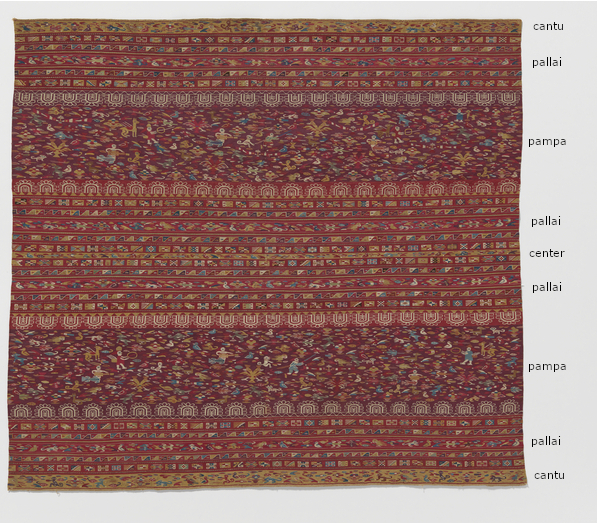
Pampa
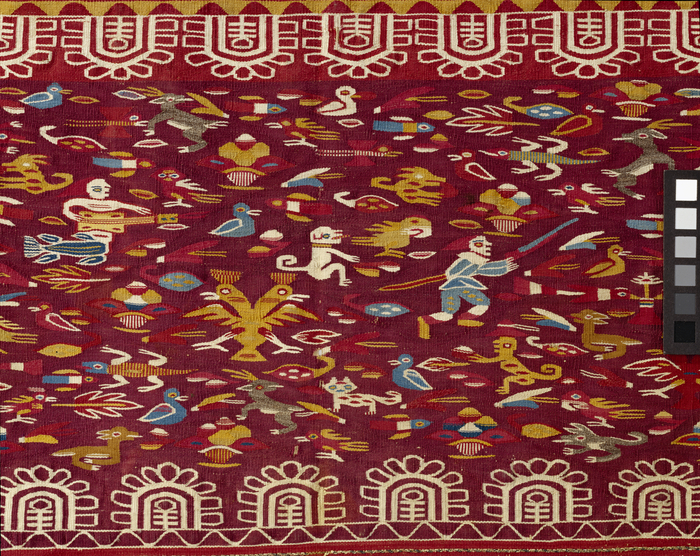
This section of the textile is called the pampa. Here we see a coming together of European and Indigenous motifs and designs. The border is an example of a ball-fringe motif that was inspired by imported European lace. Sumptuary laws limiting the wearing of expensive textiles and objects of adornment were already in place in Spain and were soon implemented in the Viceroyalties with a racialized dimension, that limited Indigenous people’s consumption of these commodities. As a response to this restriction, lace designs, like the one here, began to be woven into textiles.[1]
Besides lace, there are other European motifs found in this garment. In the center with the purple ground, there is a mermaid playing a guitar, a man in European-style clothing with a sword, and a double headed or Hapsburg eagle. These are surrounded by local animals and plants including jaguars, parrots and other local bird species, and monkeys, to name a few.
[1] Elena Phipps, Johanna Hecht, and Cristina Esteras Martín, The Colonial Andes: Tapestries and Silverwork, 1530-1830 (New York: Metropolitan Museum of Art, 2004), 193.
Detail of Woman’s Wedding Mantle, 16th or 17th century. Lake Titicaca, Peru. Tapestry weave cotton warp, camelid, metallic, and possibly viscacha hair weft, 43 3/8 x 46 ¾ inches. National Museum of the American Indian, Smithsonian Institute Washington D.C.
Cantu and Pallai
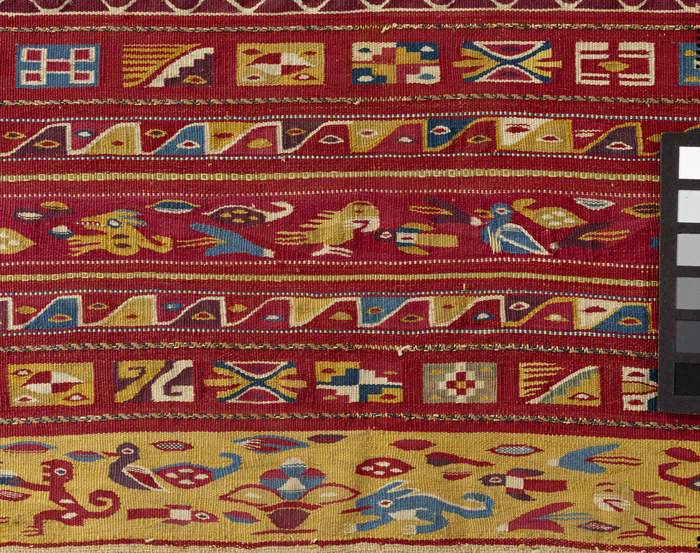
The upper section with the red ground is called the pallai. The lower section with the yellow ground is called the cantu or “mouth.”[1] The yellow ground with repeating animal and flower motifs is a common design for Colonial-era cantu. On the pallai, the squares with various geometric shapes are a colonial era design that harkens back to geometric Incan design called tocapu.[2] The meaning of tocapu in the Incan context is unclear, though we know the design was only worn by high-ranking individuals. With the fall of the Incan Empire, government control over the wearing of tocapu was no longer in place and therefore these designs began to be modified and appeared on many formal native garments, and were even worn by those who had no claim to Incan nobility. In this context, these designs represented an individual’s ties to Incan heritage and their wealth.
[1] Diana Fane, ed., Converging Cultures: Art and Identity in Spanish America (New York: Harry N. Abrams, 1996), 150.
[2] Elena Phipps, Johanna Hecht, and Cristina Esteras Martín, The Colonial Andes: Tapestries and Silverwork, 1530-1830 (New York: Metropolitan Museum of Art, 2004), 193.
Detail of Woman’s Wedding Mantle, 16th or 17th century. Lake Titicaca, Peru. Tapestry weave cotton warp, camelid, metallic, and possibly viscacha hair weft, 43 3/8 x 46 ¾ inches. National Museum of the American Indian, Smithsonian Institute Washington D.C.