
Pampa
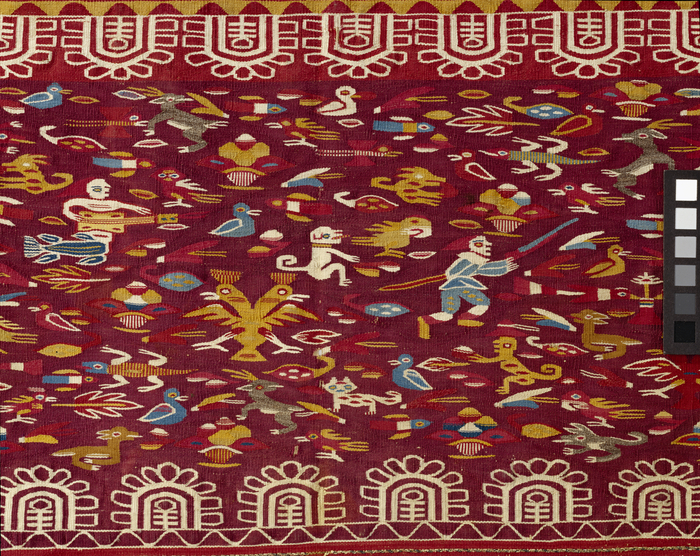
This section of the textile is called the pampa. Here we see a coming together of European and Indigenous motifs and designs. The border is an example of a ball-fringe motif that was inspired by imported European lace. Sumptuary laws limiting the wearing of expensive textiles and objects of adornment were already in place in Spain and were soon implemented in the Viceroyalties with a racialized dimension, that limited Indigenous people’s consumption of these commodities. As a response to this restriction, lace designs, like the one here, began to be woven into textiles.[1]
Besides lace, there are other European motifs found in this garment. In the center with the purple ground, there is a mermaid playing a guitar, a man in European-style clothing with a sword, and a double headed or Hapsburg eagle. These are surrounded by local animals and plants including jaguars, parrots and other local bird species, and monkeys, to name a few.
[1] Elena Phipps, Johanna Hecht, and Cristina Esteras Martín, The Colonial Andes: Tapestries and Silverwork, 1530-1830 (New York: Metropolitan Museum of Art, 2004), 193.
Detail of Woman’s Wedding Mantle, 16th or 17th century. Lake Titicaca, Peru. Tapestry weave cotton warp, camelid, metallic, and possibly viscacha hair weft, 43 3/8 x 46 ¾ inches. National Museum of the American Indian, Smithsonian Institute Washington D.C.
Cantu and Pallai
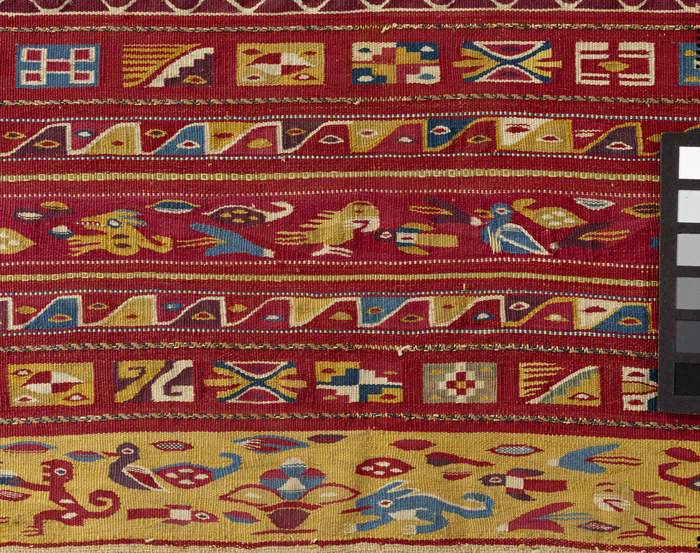
The upper section with the red ground is called the pallai. The lower section with the yellow ground is called the cantu or “mouth.”[1] The yellow ground with repeating animal and flower motifs is a common design for Colonial-era cantu. On the pallai, the squares with various geometric shapes are a colonial era design that harkens back to geometric Incan design called tocapu.[2] The meaning of tocapu in the Incan context is unclear, though we know the design was only worn by high-ranking individuals. With the fall of the Incan Empire, government control over the wearing of tocapu was no longer in place and therefore these designs began to be modified and appeared on many formal native garments, and were even worn by those who had no claim to Incan nobility. In this context, these designs represented an individual’s ties to Incan heritage and their wealth.
[1] Diana Fane, ed., Converging Cultures: Art and Identity in Spanish America (New York: Harry N. Abrams, 1996), 150.
[2] Elena Phipps, Johanna Hecht, and Cristina Esteras Martín, The Colonial Andes: Tapestries and Silverwork, 1530-1830 (New York: Metropolitan Museum of Art, 2004), 193.
Detail of Woman’s Wedding Mantle, 16th or 17th century. Lake Titicaca, Peru. Tapestry weave cotton warp, camelid, metallic, and possibly viscacha hair weft, 43 3/8 x 46 ¾ inches. National Museum of the American Indian, Smithsonian Institute Washington D.C.
Woman’s Wedding Mantle (lliclla), 16th or 17th century. Lake Titicaca, Peru. Tapestry weave cotton warp, camelid, metallic, and possibly viscacha hair weft, 43 3/8 x 46 ¾ inches. National Museum of the American Indian, Smithsonian Institute Washington D.C.
Textile production was immensely important to the Incan Empire. Textiles were valued more highly than gold and were used to represent power.[1] Cumbi was the name for the highest quality Incan textile that was finely woven with high quality threads and a controlled thread count.[2] Only a select group of weavers were trained to produce these garments to be worn by Incan nobility. With the arrival of the Spanish in 1526, this established textile tradition did not disappear, though it did undergo significant changes. The Spanish were impressed with these highly refined textiles. In Spanish accounts, they are described as “cloth of two faces” referring to the fact that the pattern appears on both sides.[3] Furthermore, the warp threads are never cut, which is a highly refined technique that creates the color blocked pattern in the textiles. These two textile innovations were new to the Spanish and they recognized the monetary and aesthetic potential they could have. Instead of dismantling the industry, the Spanish created weaving workshops using the structures already in place and required textiles as tax payments.[4] Cumbi were used as tapestry wall hangings and for decorating the homes of wealthy patrons during the Colonial era.
Even though textile production remained in the region, the introduction of sheep and European looms impacted the industry. The quality of textiles decreased significantly, due to the looser control over the industry under Spanish rule. Another change that occurred was the mixing of European and Incan motifs. The Europeans brought books, paintings, and fabrics including lace, to the region which inspired Incan weavers to include new motifs in their textiles.[5] For example, if you click on the pampa section of the textile above, you will see an imitation of lace woven into the textile.
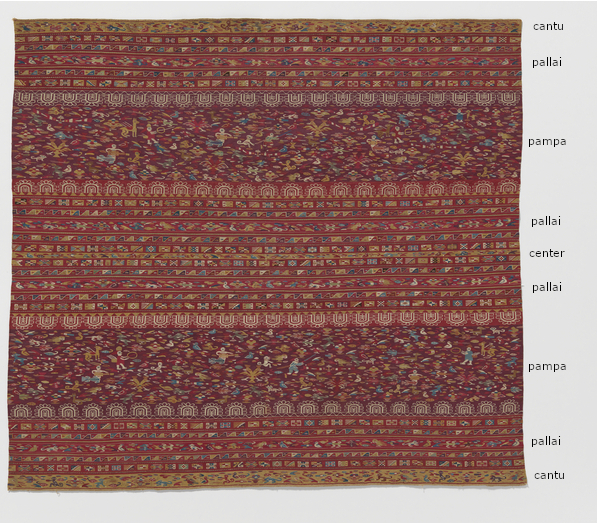
The structure and organization of textiles largely remained the same, especially in early Colonial textiles, like this mantle here. The organization of this garment is strictly Incan and can be divided into three sections called the cantu, pallai, and pampa which are labeled on the image.[6] Click on one of these sections to learn more about the mixing of Indigenous and European motifs in Colonial era textiles.
[1] “All T’oqapu Tunic,” Dumbarton Oaks, accessed December 9, 2021, http://museum.doaks.org/objects-1/info/23071.
[2] Elena Phipps, Johanna Hecht, and Cristina Esteras Martín, The Colonial Andes: Tapestries and Silverwork, 1530-1830 (New York: Metropolitan Museum of Art, 2004), 21.
[3] Phipps, Hecht, and Martín, 23.
[4] Rebecca Stone-Miller, To Weave for the Sun: Ancient Andean Textiles in the Museum of Fine Arts, Boston (London: Thames & Hudson, 1994), 64.
[5] Phipps, Hecht, and Martín, 80.
[6] Phipps, Hecht, and Martín, 32.
How this Mantle Would Have Been Worn
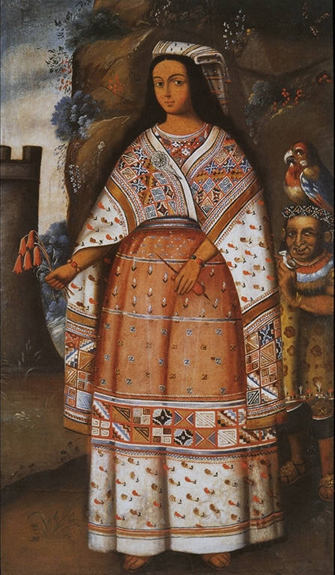
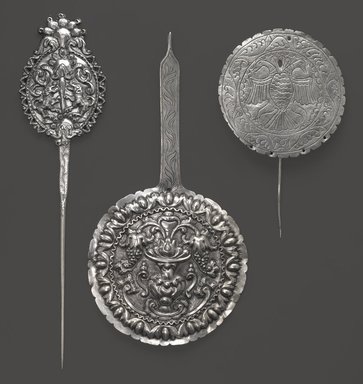
This textile is a worn garment called a mantle or in Quechua, a lliclla. It is a traditional Incan style garment that would have been worn by both men and women. The mantle would have been draped over the shoulders and, for women, pinned in front with a large decorative metal pin called a tupu.[1] After the Spanish defeated the Incas in 1532 and began to take control of the region, laws restricting the wearing of traditional Incan-style garments were enacted. Early Viceregal government officials worried that the traditional Incan garments were indecent for women because of their loose fit. Therefore, both men and women were encouraged to wear tailored European garments. In 1575, Viceroy Toledo prohibited the wearing of Incan style garments except in certain circumstances. These included during Colonial festivals such as Corpus Christi, weddings, and the deaths of Spanish rulers. These garments were permitted in this context as a “performance” of Incan identity.[2] There is evidence in portraiture, like this portrait of an Incan Ñusta or princess, that wealthy women of Incan heritage did wear these garments to have their portraits painted as a representation of their Incan heritage and high social status. These garments, especially the ones of highest quality, were also commissioned for weddings as is most likely the case with the textile above.
[1] Diana Fane, ed., Converging Cultures: Art and Identity in Spanish America (New York: Harry N. Abrams, 1996), 148.
[2] Elena Phipps, Johanna Hecht, and Cristina Esteras Martín, The Colonial Andes: Tapestries and Silverwork, 1530-1830 (New York: Metropolitan Museum of Art, 2004), 27.